
Innovating a Legacy Business: Adapt, Die or Just Start Over?

My profession exposes me to many young companies that feel the growing pains and pressure to keep up with the latest technologies and innovations. Although this is always challenging, young businesses typically have flat management hierarchies, small teams and flexible technology platforms that can switch their business model or build out new features at a moment’s notice. But what about those companies that have been around for years?

Last week, I met with two successful entrepreneurs (and dear friends) who are at a cross roads with their legacy business.  The business has historically generated a few million dollars in EBITDA, affording them large salaries and a coveted lifestyle. Despite this success, they, like many established businesses, have been facing the challenges of keeping pace with new technology and innovation in their industry.

Over the last three years, they have been trying to figure out how their industry’s increasing dependence on data could enable them to scale very rapidly.    They have been focused on investing into a more robust technology platform to afford them greater economies of scale with additional product offerings to generate incremental revenue from their existing customer base.

For a legacy business, big or small, innovation on any level is very difficult. If and when management decides it is time to innovate, they need to be prepared for the greater organizational change that might very well have a negative domino effect, impacting HR, budget, revenue, and the overall health of the business. This can stress founder relationships and affect early employees that no longer fit the direction of the business. For good leaders, this is often an emotionally taxing period when loyal employees must move on for a myriad of reasons.

For these entrepreneurs and many others, they have recently been experiencing growing pains driven by a rapidly changing technology component within their business.  Although they have been investing heavily to improve their product, they are still struggling to launch an innovative, new platform to meet their customer needs. This predicament is what Clayton Christensen, of Harvard Business School, dubbed in his book “The Innovator’s Dilemma.”  The innovator’s dilemma is the “difficult choice an established company faces when it has to choose between holding onto an existing market by doing the same thing a bit better, or capturing new markets by embracing new technologies and adopting new business models.”

So, as an early stage investor, it should not surprise you that I have seen the most disruptive innovations come out of start-ups, not from long-standing companies. Start-ups are forced to be scrappy, creating solutions with a very tight budget with very little manpower. This leads to solutions that can be rapidly tested until the cheapest and most scalable one is found. Legacy companies and other established companies must deal with the red tape surrounding upper management, combat old and established systems, and think about tenured employees before testing even one innovative idea.

My friends are now trying to assess whether or not it is the right time to separate their new product vision into a new company and sell their legacy business.  My friends have worked really hard over the last 12 years to even have this option, albeit a difficult one.  This new strategy would provide them the capital to fund the new company and allow their technology team to focus only on the new platform. With sufficient capital and a tech team that already knows the industry, this new company already has a potentially higher rate of success than most. This would enable them to reach market faster, avoid distractions from legacy issues and invigorate the engineers who are fatigued from the dual responsibilities of innovation and maintenance.

So the question is, what do you think they should do?
Innovating a Legacy Business: Adapt, Die or Just Start Over?

Is your Venture Capital Firm Having an Identity Crisis?

Imagine this: you’re in front of a nervous young entrepreneur pitching their idea for the next Uber.  They are a first time entrepreneur whom you met at a cocktail networking event, an event you didn’t even want to attend.  They are trying to convince you that their $10 million dollar valuation is warranted.  Yet, they have no idea what a cap table is and no idea how they are going to monetize their business.  You are so tired of asking the questions they should have already answered.

And then you ask yourself: how did I get here? Why did I even agree to take this meeting?

Sound familiar?

You might need to take the same advice that you’ve given to your entrepreneurs: take some time and figure out what your specialty is and what you want to focus on. For VCs, this implicitly defines your investment thesis.

As most of you already know, an investment thesis is the formula of beliefs and criteria used to determine what investments to pursue and why.

What We Look For

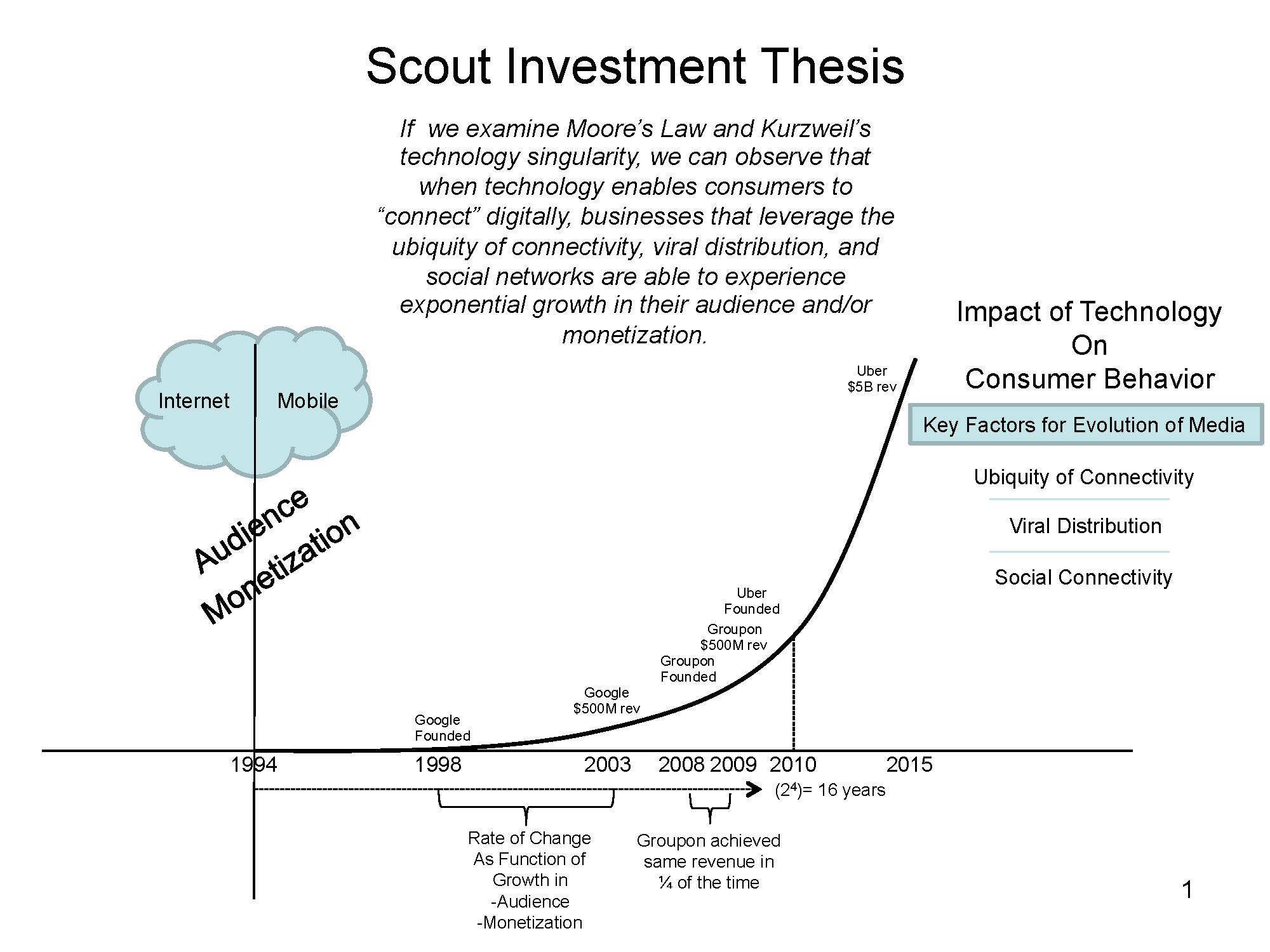
From the very beginning of Scout Ventures, we’ve put heavy importance on figuring out who we were as individuals and who we wanted to be as a firm. As the Founder, I knew I wanted to build a firm that explored how technology enables consumers to connect “digitally” and then leverage the ubiquity of connectivity, viral distribution and social networks to experience exponential growth in their audience and/or monetization.

Investment Thesis 5-18-2015

Putting it in Practice

In order to explore and leverage these ideas, I knew we had to:

1) Put a process in place that would lead us to discover and invest in the best entrepreneurs and companies that fit with our own backgrounds and expertise, and

2) Figure out the best way we as a firm could then help these entrepreneurs and companies to evolve and grow into their potential.

Let’s talk about the process first. Over the past few years, we have established what we call ‘filters’. We refer to these when deciding to take a meeting and when we are considering investing. It is important to apply consistent filters across the board; for example, we know we don’t invest in HR based companies, so we would politely decline a meeting with one. Be sure to keep a growing list of filters to refer back to.

At Scout, we’ve identified over forty parameters that we use to evaluate a deal. These parameters range from highly quantitative statistics such as MRR and burn to more qualitative aspects such as founder balance and market structure dynamics. Through introspective analysis and reviewing our 55 investments, we have been able to develop pattern recognition techniques that identify what specific characteristics exist across our most successful portfolio companies.

If you are not established enough as an investor to be able to decide these from your own historical data, then start with qualitative filters. For example, we prefer to invest in seasoned entrepreneurs and in teams who we were introduced to via a trusted advisor, entrepreneur or friend.  Through the use of simple filters and parameters we make sure we don’t take on too much, don’t take on anything where we do not feel we can add value and most importantly, we make sure stay true to our investment thesis. 

If you are a new firm, don’t stress over this too much. It has taken years to truly establish our current base criteria for taking a call or listening to a pitch and deciding to invest. And don’t forget, your thesis and filters are also something that should be constantly evolving.

Investing More Than Money

I like to think that most VCs don’t just stop at finding the entrepreneur and writing a check. But that’s not always the case. Ever since I started investing years ago, I always found the most rewarding part to be what happens after the check has been written, and I’m not just talking about the potential monetary returns.

One of Scout’s key activities is adding value to those we invest in. We don’t just invest money; we invest time. We start helping the entrepreneur from the minute they walk into our office. When we feel that immediate connection and know that the chemistry works between our team and the entrepreneur(s), we’re already at work thinking about what we can do to help. The first thing we’ll do is open our rolodex and introduce them to people we know can help them in ways we might not be able to.

At Scout, we are entrepreneurs. Our venture just happens to be a venture capital firm. Because of this, we know first hand what struggles entrepreneurs are going through and will go through. And when we help you, we are not only taking into consideration our own experience building the firm, but also taking trends from the data we’ve collected on our 50+ investments. We’ve seen it all.

In summary, if you think your firm needs a thesis overhaul, or even the creation of a thesis, be sure to base it on what your team is passionate about but also on what is practical for the size of your firm and fund. After all, this is how you differentiate yourself from the ever increasing number of firms. The entrepreneurs you attract and invest in will mirror the quality and authenticity of your thesis, so don’t rush it.

Is your Venture Capital Firm Having an Identity Crisis?

How to Raise $20.5 Million Dollars the SignPost Way

This month our longtime portfolio company, SignPost, humbly announced the close of their $20.5 million dollar Series C.

The Company offers consumer marketing tools and manages its customers’ presence on sites like Yelp, while leveraging data from credit card transactions and social media to send targeted marketing messages that drive sales, referrals and reviews.

For Scout, it is a proud day because Stu Wall was one of our first entrepreneurs when we launched Fund I.   We were originally introduced to Stu through another one of our entrepreneurs, Dan Gellert.   Dan is another great entrepreneur with a special place in Scout’s legacy, as he was one of my first board seats.   He sold his company GateGuru to TripAdvisor which enabled us to make our first LP distribution in Year 1 and gave us the credibility to raise more money.

As I reflect on how proud I am of both entrepreneurs and the journey I’ve experienced with them as an investor, I think its important to reflect on how we got here and how to replicate this relationship with more entrepreneurs.

(1) Our best deals are normally sourced through our entrepreneur network.   This is why its so important to always treat an entrepreneur with a level of mutual respect.

(2) When you get to meet an amazing entrepreneur, have the mindfulness to identify their potential and don’t be caught up in the day to day to miss the opportunity.

(3) Each and every relationships between an entrepreneur and investor is based on trust and communication.  Without these two key variables, its difficult to build a company that can win.

(4) As an investor, as soon as you find a kick ass entrepreneur don’t hesitate in helping them build and motivate their team.   No great entrepreneur can build an awesome company without a supportive and passionate team.  Stu asked me to talk to the entire Signpost team (now 213 strong!) the day before we announced to them the news of this raise.  I was inspired and I think the team was pretty fired up as well.

Building great companies is hard to do and it takes a really, really long time.

Don’t rush.

Value each entrepreneur and spend your time making a difference, not being a pain in the ass.

***This post is dedicated to the memory of a new and dear friend.  All of our hearts are a little less full tonight.  We love you Kelsey.***

How to Raise $20.5 Million Dollars the SignPost Way

Talking Tech With MeetAdvisors: Do VCs Read Business Plans?

I was recently invited over to MeetAdvisors for an interview with one of their hosts, Rachel Pollard. MeetAdvisors is a great platform where entrepreneurs can search for, find, and network with advisors and fellow entrepreneurs.
Rachel and I spoke about the recent history of startups, the genesis of Scout Ventures, how we view where technology is going, and about a very pressing question: do venture capitalists read or care about business plans?

Click here to watch the interview!

Talking Tech With MeetAdvisors: Do VCs Read Business Plans?

The Importance of Responding to Email

There’s been a lot of discussion lately about the proper use of email since the Sony – North Korea incident.   In fact, Fred Wilson and one of our co-investors Gotham Gal got wrapped into the drama and Fred shared some great advice on limiting what you put in email.

I’ve been spending the last several years trying to examine how I interact with email and determine how this impacts my relationships, potential liability and in general, my communication skills.

It’s important to note that from my West Point and military background, it’s been ingrained that that you should always properly follow up with people whether that’s returning phone calls or emails.

I try to bring the same level of discipline to my work life.  While at AOL, I found it invaluable to always send a note and tell someone how nice it was to meet them.  This has served me extremely well and enabled me to build a very strong network of people in media and tech – many of whom have ascended to C-level positions.

Unfortunately, the flow of information is too much.    I’ve turned to tools such as SaneBox (thanks to Tom Katis) and Followup.cc (thanks to Ari Meisel).

While these tools help unclutter my inbox, I still try to invest the time into responding to entrepreneurs.  As an entrepreneur, I know how tiresome fundraising can be so I try to exercise mutual respect and respond.    Sometimes the inbound email doesn’t make it through SaneBox, so if I don’t respond, I might not have seen the email.

I think it’s important to touch on a point that Fred made in his post, which is that everyone should consider their emails as public information.   Whether you get hacked or not, if you limit what you write in email, you will be thankful in the long run.   I find this to be especially true when dealing with a legal matter, HR or any sensitive subject.  In most cases, its better to just pick up the phone.

The Importance of Responding to Email

Three Things That Kill Early Stage Companies

As a VC, we spend a lot of time thinking about where we want to invest our money.   Last night, I was with my friend Pedro Torres-Pincon who recently presented “How to Build an Investment Thesis”  providing good insight into determining how and where you decide to invest your money.

But writing the check is the easy part.    The real challenge in entrepreneurship is to build a meaningful and sustainable company.   To that end, one of the things we like to discuss at Scout with our founders is how to avoid the pitfalls that can kill an early stage company.

(1) Don’t run out of money.    I know this seems like a simple rule but it’s amazing how many entrepreneurs under estimate how much time and money they will need to build their business.   In most case, we see financial projections that too aggressively forecast revenue growth, while underestimating the cost of building a scalable product.    The other issue that tends to crush entrepreneurs is not allocating enough time to raise the next round of capital; fundraising is time consuming and requires a focused effort.    So beware – forecast more conservatively and budget more time to raise your next round of capital.

(2) Don’t make a bad critical hire.   We often invest very early in a company when they haven’t hired all their critical team members.  In many cases, our capital is being used to expand the team and help the founders grow their vision.  If the Company hires a rock star then everything will get much better, but if they hire a dud then the Company is sure to suffer.   The two areas that are most often affected are  technology and sales.    If the company is in the process of building a new product and their new CTO drops the ball, then it’s almost impossible for the company to meet any of their deadlines or achieve the metrics necessary to secure the next tranche of capital.    Likewise, if the Company hires a revenue generator like a VP of Sales and they fail to achieve their revenue goals, it’s often a devastating blow to the company’s forecasts and thus also hurts their ability to raise additional capital.

(3) Avoid bad investors.   The early stage landscape is much different today than it was when I started in this industry as there is more seed stage money than ever before.   Accredited investors are jumping into early stage investing with angel groups, accelerators, and equity crowd funding platforms like SeedInvest. This coupled with significantly lower barriers to entry means that it’s easier than ever to start a new company and raise a small amount of capital. The resulting increased competition among early stage companies has created a shortage of follow-on funding as described by Josh Kopelman of First Round Capital.    But more hazardous than the shortage of Series A capital, is the impact inexperienced investors, often from other industries who are looking to dabble in venture as an alternative asset class, can have on an early stage company.    The worst case scenario for a young entrepreneur is to get lured by an investor who is offering capital but wants to add terms and provisions inconsistent with standard early stage venture rounds.    These terms vary greatly but the most dangerous are the right to ask to get paid back, asking for too much control and/or the need for the investor to consent to future financing, etc.    It breaks my heart when a young team is crushing it only to have a disgruntled early investor call their $100,000 note – which represents a significant chunk of operating capital.    Smart money is always the best way to go.

Three Things That Kill Early Stage Companies

Advisors

As an entrepreneur and investor, I have also been asked to play the role of advisor.

The term “advisor” is often used without clearly defining the role and expectations of said advisor.  Many entrepreneurs think that adding a roster of high profile advisors to their investment deck will lead to greater credibility and thus ultimately help their fundraising efforts.

In my experience, many entrepreneurs including myself, have a deep and diverse set of advisors and mentors.   The key is to understand how to properly engage these people to create value and leverage their experience and expertise.

There are some simple guidelines to consider when engaging someone as an advisor:

  • Will there be a formal relationship or is the advisor really more of a mentor?  A formal relationship normally comes with some written letter or agreement outlining the advisory role
  • What will be the economic value exchanged for the advisory role?   It is important to clearly define the amount of advisory shares and/or cash compensation.  We normally see advisory shares in the 0.20% to 1.0% range and occasionally up to 2.0% depending on the role, seniority, deliverables, etc.
  • What are the expectations of the time commitment of the advisor?   Many entrepreneurs complain that their advisor was very active at the beginning and then unavailable.  It’s critical to discuss the advisor’s availability and how much time they will commit
  • Determine the focus and/or deliverables of the advisor?   This normally includes introductions to investors, help with commercial relationships, recruiting, strategic advice, corporate governance and a host of other areas where an advisor can help

Once you’ve properly framed the advisor engagement, then it’s time to work together to build your company.    I think it’s important to remember the principles of reporting when dealing with advisors.   It will provide a good framework to measure the effectiveness of the advisor and make sure both parties are happy with the relationship.

It’s also important that you maintain a way to terminate the relationship with the advisor if it’s not working out.  There is nothing worse for an entrepreneur than feeling like they gave up a bunch of equity and they aren’t getting value.    I often think there is a disconnect between entrepreneurs and advisors when they haven’t properly defined the advisor engagement.   Often advisors might think they are doing a great job and the entrepreneur is actually looking for a different contribution or better results.    The worse resolution of this situation is when the entrepreneur, who originally committed to giving a formal written advisor agreement, then decides 6 months or a year later that they no longer need to honor the verbal agreement.    This can then be exacerbated by the entrepreneur using excuses like “the board didn’t approve your options.”    If it’s not a fit, then own up to it and find an amicable dissolution.   Don’t be shady.

My key takeaway is that a solid advisor can materially help your business, provide critical experience and expertise, and increase your bandwidth.    But it’s important to take this relationship seriously and add the right pieces to make it successful.


Advisors

Being Healthy Is Everyone’s Responsibility

The other day I read a shocking Wall Street Journal article about a new class of cholesterol drugs that could potentially add an additional $150 billion to the national health-care bill.

Apparently, there are currently 32 million Americans taking statins, such as Lipitor, and millions more that would get prescribed the new PCSK9 to regulate cholesterol.

My lovely wife, Angie Harrison, works for the American Heart Association. So we are both very conscious of heart disease and the need for people to take care of themselves. We are also both committed to our kids, Scout and Elvis, and therefore we have decided to live cleaner and healthier lives as we get older. Unfortunately, this commitment takes a lot of hard work and requires sacrificing many of the things that people consume on a daily basis.

My concern is that most Americans don’t want to make the change required to be healthy. I know that I’ve struggled year after year, diet after diet, and cleanse after cleanse trying to be healthy. I try to do yoga at least once a week, exercise three-five times a week, and eat clean 90% of the time.

But for people who are currently unhealthy, ignoring exercise, eating and drinking whatever they want, they are actually not only ignoring their own health responsibility, they are jeopardizing the health of everyone in the national health system.

I just finished a focused effort to clean my diet – the result after 1 month:

  • Perfect blood pressure (110/70)
  • Perfect cholesterol (142)
  • Healthy sugar, kidney, and liver functions
  • Normal thyroid, prostate, and other tests
  • Weight 181 lbs (down from 197 lbs)

So what was a Clean diet:

  • whole vegetables and leafy greens
  • whole fruits & berries
  • wild fish, organic chicken & turkey
  • brown rice, quinoa
  • beans, legumes, lentils
  • nuts, seeds & nut butters (no peanut)
  • avocado & coconut oil
  • No gluten
  • No dairy
  • No meat, pork, eggs, shellfish, no raw meat or fish
  • No corn, no soy
  • No nightshades (tomato, eggplant, peppers, potatoes)
  • No bananas, strawberries, oranges, grapes
  • No coffee, soda, alcohol
  • No processed sugar

The key to success – be vigilante for at least 5 out of 7 days and don’t beat yourself up when you enjoy drinking or eating something off diet. For me, I was pretty strict and I found that I didn’t have the cravings to cheat. For many people, after getting clean the body doesn’t always like the old unhealthy food resulting in upset stomachs and/or diarrhea.

We all need to have meals where we don’t watch what we eat or drink. Tomorrow night is a big dinner for Greg Parsons and we plan to have fun, eat a great meal and drink some nice wine.

My experience is that if you are more healthy than not than you’ll feel better, go to the doctor less and as Mr. Spock would say “Live long and prosper.”

Being Healthy Is Everyone’s Responsibility

Reporting

Reporting is one of the most important tools for any management team to effectively run their business.  But unfortunately, its a skill that most entrepreneurs lack.  This is the result of many entrepreneurs never working in an organization that stressed the importance of reporting and accountability.  It is also the result of most entrepreneurs viewing reports as a big time suck instead of a valuable tool.  Thus, entrepreneurs tend to avoid developing a consistent cadence of reporting with their teams, investors, and/or advisors.

Here’s why reporting can make all of us better:

(1) It demonstrates an understanding of the metrics that drive your business and are critical to keeping the team focused on what is important

(2) Holds everyone accountable for their performance

(3) Sets a culture of openess and transparency

With that said, our portfolio company LeagueApps delivers a solid monthly report on the 5th of every month.    We like their format:

  • Health of businesss
  • Key Headlines
  • Summary of Performance Metrics
  • Financials
  • Investment / Capital Requirements
  • Business Highlights
  • Product Update
  • Technology Update
  • Personnel Update
  • Marketing, Press and Media Coverage
  • Areas that Need Improvement
  • Personal Updates on team, family, etc (ie founder has new baby)

We hope this helps.

Reporting