Olapic Acquired

Today, a company where I was the first investor was acquired.

http://www.businesswire.com/news/home/20160721005362/en/Monotype-Announces-Intent-Acquire-Olapic

What makes this so special is that these are just some of the most amazing guys I’ve had the opportunity to work with – ever.

And Olapic, like many start-ups, had several pivots before they found their product – market fit.   And it was the personalities and determination of these intelligent and happy founders that attracted an amazing group of advisors, mentors and investors.

I couldn’t  be more proud.  This is why I do what I do.

Congrats to Pau, Jose and Luis – you deserve everything!

Olapic Acquired

How to actually make America great again

I original drafted this post prior to the incidents in St. Louis, Louisiana and Dallas that rocked our nation last week…

As I reflect on this 4th of July celebration, I am overwhelmed with the realization that as a “people,” we have lost touch with the ingredients that actually made this an amazing country.  The country I have loved from my earliest days.  The country I swore an oath to defend against all enemies foreign and domestic.  The country that is supposed to be the land of the free and the home of the brave, America, where anything is possible.

Well, I think its fair to say that we’ve totally screwed that up and if we don’t fix it now, we are likely to experience continued civil unrest, increased violence and turmoil until we implode.

At the root of our current troubles is the fact that most of Americans forget that we were all once immigrants (except Native American Indians who were the first to get screwed). Regardless of our race or religion, the inhabitants of the United States all came from somewhere else.  For everyone, it was a difficult journey to get here.  And then it took us about a century and a half of settling and building this country to establish our sense of identity as a nation.  In the middle, our nation was almost destroyed by slavery and racial inequality.  Then it was our unity through World War I and World War II that made this the greatest country in the world.   Every man, woman and child was committed to the cause as an American.  It was this indomitable spirit that ultimately lead us to the moon.   Since then, I think we’ve lost our way…

First, we have very much lost our sense of community.  While some of us are part of micro-communities (church, school, sports), most of us are not active members of our broader community.   Most citizen have some level of fear over the police and government regulation. The motto “to protect and serve” seems to be a long way from the current relationship between the people and the police in certain communities.  Furthermore, most people don’t know many of their neighbors or have a relationship with the people in their community that help make sure things work – we take everything for granted.   In the age of selfies, Snapchat and Facebook, we are less connected to people in the real world. We need to remember that in the past, our strength and power came from our unity and community.   We need to find common ground on how we should live as Americans.

Second, we seem to lack common values.   While we seem to all argue for our various needs – right to bear arms, abortion, gay marriage – we don’t seem to first argue that all Americans should have food, water, shelter and safety.    We’ve have become so polarized on political issues and government regulations, that we’ve actually lost touch with the freedoms that were the basis for our way of life.    When I go to small towns, while I still see the white picket fence, I can’t seem to find the children riding their bikes and playing in the parks.   Now everything is supervised and regulated – even a kid riding his bike to his friends house.

Third, we have lost our way as a leader and role model.   Our public figures and political leaders consistently reveal their flaws of integrity and judgement.  We have lost much of our influence as a country that represented freedom and opportunity.  In the past, America was respected for our commitment to life, liberty and the pursuit of happiness.   Now the world largely views us as an unintelligent country of overweight, entitled people with a broken health care system, excessive gun violence, unstable race relations, and an ineffective government.

Fourth, is greed.   We have gone from capitalists focused on innovation and investing, to a nation driven by corporate profits, increasing the wealth of the wealthiest, and consuming more and more and more.  Our number one advertisers on television are pharmaceutical companies promoting drugs.   We’ve seen the death of almost all the homegrown industries that were pioneered in America.   We’ve sacrificed our independence in order to increase profits through outsourcing and lower standards.  China is kicking our ass and Russia does whatever they want – because both of them can.  What we need to realize is that true capitalism needs to understand sustainability.   We must be able to sustain our way of life and that means reevaluating the entire system and how we live together.

But this doesn’t mean that all is lost.   It means that we need to take a good long look in the mirror and decide where we want to be in the next 20 years.

So where do we start?

I think we need to first take a step back and look at the bigger picture.   As Americans, we’ve always thought of ourselves as pioneers and ultimately world leaders.  And any great leader will pause from time to time and reflect on the good and the bad.

Right now many people feel like all is lost and we are doomed.   I feel that way some days.

But we also need to see all the good that’s happened in the world.  In general, everyone’s quality of life has improved, as has overall life expectancy.  But we are still plagued with hate and violence.

So, what if we started the conversation with the goal of rebuilding this nation and world to live together in peace where all human beings have food, water, shelter, security, community and love.

Does this sound impossible?

Every day the men and women in the military live this way.   They are a community, with a set of common values aimed at protecting our country and way of life.  The members of the military want peace more than any other citizen.  Military commanders act as role models and leaders – Washington, Grant, Eisenhower and even Jimmy Carter went on to lead our country.  Every soldier knows they are a member of a specific unit while part of the larger military community.  Every soldier has a job. Every soldier plays a different role in providing food, water, shelter and security to their community.

And when these men and women are in harms way, their community becomes even tighter.  They become more disciplined over protecting key resources like food and water.   Security is their number one priority.  And there is a common bond – a genuine love for your brothers and sisters in arms – who you need to survive.

And in this community there is no greed.   Every soldier gets the same pay based on their job, the number of years of service and their rank.  So profits and capitalism don’t impact the dynamic.

Now, I am not saying that we need to live like we are all in the military.   But what if all acknowledged that at the root of our existence we are all tribal.   We love, we laugh, we dance, we sing, we make babies, we smile, we cry but ultimately we all have a will to survive.

In the military, I was an Infantry Officer, Airborne Ranger and ultimately a Division Civil Affairs officer.   While I spent the majority of my career training to go to war, it was my time as the Civil Affairs officer where I learned how to interact with different communities to reach a peaceful co-existence without ever using a weapon or spilling a drop of blood.   The majority of my success was having a basic understanding that every community and tribe needs food, water, shelter, and safety.

For those of you that have attended Burning Man, the organizers have realized that we can police our own community using UNARMED individuals from the community who come to handle any issues or complaints.  99% of the time they resolve the issue on the spot.  1% of the time they call the next level of ARMED sheriffs and BLM officers.   I don’t think an ARMED officer has ever killed a participant in a place where the majority of the community is intoxicated on alcohol and drugs.

Maybe, this all sounds too much or requires us to step to far outside the bounds of our current reality.

But the inevitable future is one where most people do not work and are subsidized.  So we need to figure out how to make sure everyone has the most basic, tribal needs of food, water, shelter and safety.   

If you think this is silly, then please explain what we do over the next 20 years when the majority of American jobs become obsolete.   Currently, the number one source of employment for males in the United States is driving or driving related.    Driverless cars, Hyperloop, and drones will eliminate most if not all of these jobs within the next few decades.  This will greatly challenge our ideals of capitalism.   This will greatly challenge our current system of taxation.   It will require that we re-imagine the way we live, the way we co-exist and the meaning of life.

How to actually make America great again

Good day

The other day was a rough day.

One of our companies failed to find a buyer and let all their employees go.

Over dinner my dear friend Joey Hundert provided support and counsel while reminding me that as entrepreneurs our lives are full of peaks and dips.

He assured me it’s okay to be genuine in the emotions we feel when companies fail. And I was sad and disappointed.

Then yesterday I was reminded of the emotions when companies succeed.

And that is being proud of our entrepreneurs

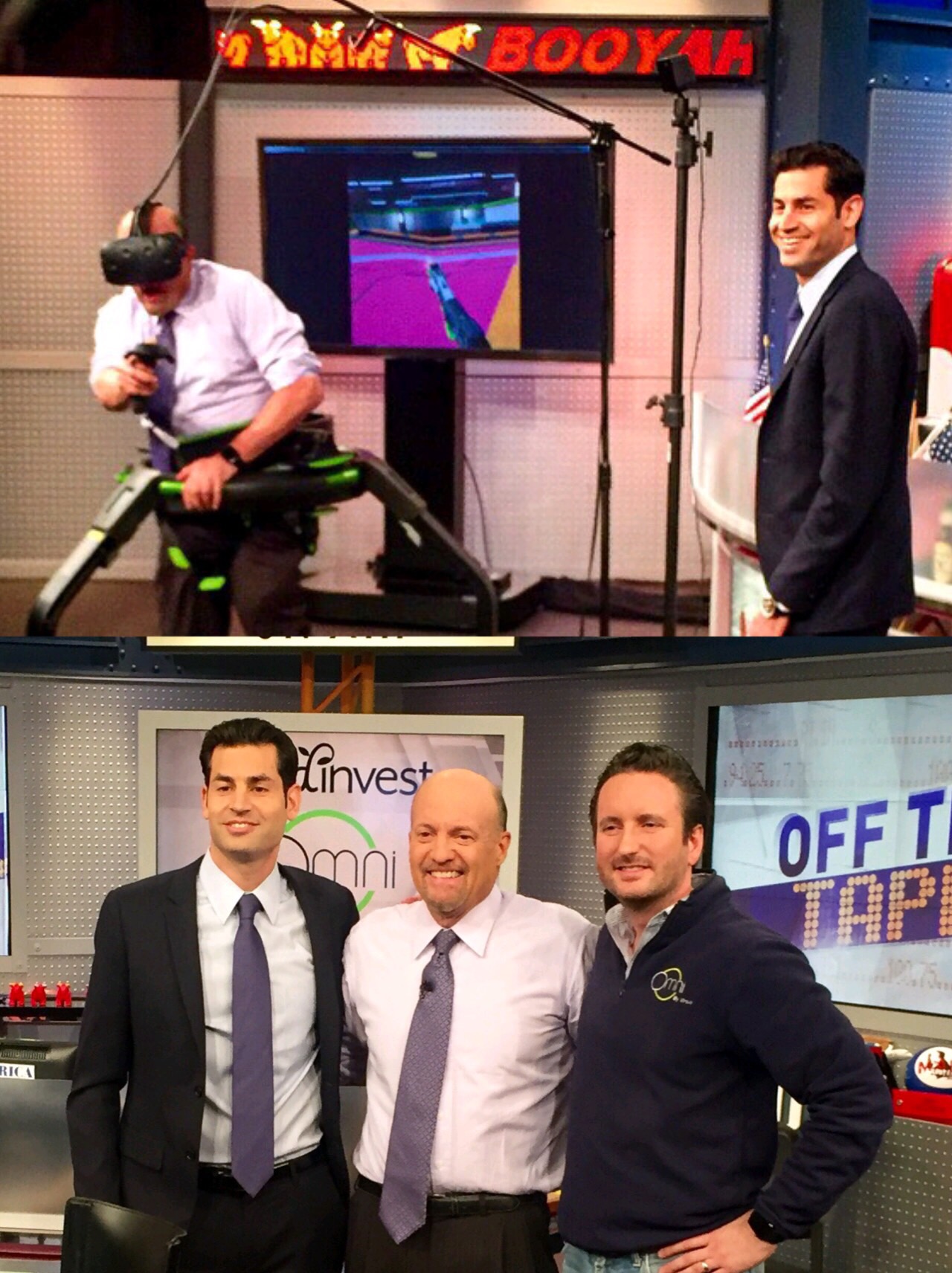
  • Ryan Feit of SeedInvest (where I sit on the Board) and Jan Goetluck of Virtuix (where we are also investors) were on Jim Cramer Mad Money.   They were promoting both equity crowdfunding and the disruptive VR technology as they partner to raise one of the first Title IV of the Jobs Act deals from both accredited and non-accredited investors.

And just like that four of our entrepreneurs remind me of why I love what I do.

Yesterday was a great day.

Good day

Be Sustainable

In today’s modern day, many of the ideologies of what is good for humans and our planet are very different than in the past.  With more knowledge around health, the environment and the need to be sustainable we are all required to reexamine our behavior and think about our future.

In the United States post World  War II, the USDA shifted our food pyramid to represent a diet based on milk, meats, fruits & vegetables, and grains.  At the same time, food companies began to process much of the food we eat to extend shelf life and reduce cost. We now know that many of these recommendations were not the result of science but rather the result of lobbyists for dairy, wheat, and other interest groups looking to make their products part of everyday life.   In addition, most corporations looked to drive profits by reducing the amount of real food in their products with processed substitutes and chemicals; my least favorite being the replacement of cane sugar with high fructose corn syrup.   (Again, the government supporting the corn industry over the cane industry)

Over the last 7 years, I’ve been committed to helping America return to high-quality, unprocessed food.   One of my favorite companies is www.greensburymarket.com which sells organic and sustainable meat and seafood sourced from family farms and fisheries and delivered right to your door.    As we were starting Greensbury, I learned some very interesting facts about the food supply chain in the United States.

A staggering 133 Billion pounds of food worth $162 Billion is wasted each year according to the United States Department of Agriculture (USDA).  The average American household is throwing away roughly $120 each month through uneaten food.   And the waste is even worse from the processing plants to delivery companies to supermarkets and households, where ‘fresh’ food is being dumped at a rate of 222 million tons a year.

That’s why at Greensbury, we realized that processing and flash freezing the product is actually a much more healthy and sustainable way to buy your perishable proteins.  When I went on a fishing trip to Alaska in 2004, the local fisherman told me that all fish are processed and flash frozen to not only lock in freshness but to kill bacteria.

If you go to Whole Foods and buy a steak, that meat has already been transported, thawed, moved around the store and touched by multiple butchers before it’s sold to you as the end consumer.  Furthermore, the blood and moisture has normally been drained as it sat in the food counter waiting for you to buy it.   If you don’t cook the meat within 24 hours, the product will often change color and start to smell within 48 hours.   With Greensbury’s sealed products, the blood and moisture is captured within the product so when thawed it returns to the texture and freshness as if it was just slaughtered.   And from a sustainable perspective, the food will last at least 6 months if properly stored and if you take a steak out to thaw in your refrigerator but don’t cook it right away, it will last 5-7 days in your fridge if you haven’t broken the vacuum seal. Clearly, a more sustainable way of dealing with perishable items.

Be Sustainable

Hard Work

I took a  few months off from blogging as I’ve been buried with some key deliverables related to launching Fund III and relaunching Greensbury.com

While I’ve been on my hiatus, I’ve very much enjoyed reading thoughts from industry experts like Fred Wilson and Brad Feld.    They both have a tremendous amount of experience that translates into valuable lessons as market cycles – good and bad – repeat themselves.

For me today I  wanted to have a quick conversation about hard work.

I have always worked hard.

I have always done my best.

And I normally do my best without any expectation of praise or acknowledgement.

It was simply the way I was raised.

So with that said, I’d love to hear people’s opinion on how millennials are doing within their organizations.

And are they working hard?  Do they follow instructions?  Are they attentive in meetings?   How many times do they need to discuss what needs to happen before someone takes action?   And do they stay late to get the job done or are they punching out right after 5pm?

One of my favorite pieces from last year is Derek Thompson A World Without Work where he contemplates a world where technological advances reduce they number of people who are fortunate enough to work.   For example, Mr. Thompson cites the number one source of employment for males in the United States is driving and that job is going to be threatened by self-driving vehicles.

In a world where work may become a privilege, hard work and a proper work ethic become a critical component.

So I ask again, how are millennials doing in your organization?


Hard Work

The Mighty 25: Veterans poised for impact in 2016

Happy to share this list (originally posted here) courtesy of We Are The Mighty. What makes me even more excited is the fact that some of our founders are on the list. They are Blake Hall of Id.me, Taylor Justice of Unite US, John Roger Jr. of Local Motors, and Jeremy Gocke of Ampsy.

Cheers to 2016 everyone!

Within the worlds of politics, business, advocacy, and media there are veterans who continue to serve in a wide variety of ways.  Men and women who once fought the nation’s wars now shape the American landscape by doing everything from building cars with 3D printers to creating fashion trends, from making major motion pictures to passing laws.

The editors of WATM (with inputs from a proprietary panel of influencers) scanned the community and came up with a diverse list of those with the highest impact potential in the year ahead.

Here are The Mighty 25 for 2016:

mcchrystalSTANLEY McCHRYSTAL — Co-Founder, The McChrystal Group

After a legendary career as an Army special operator, highlighted by effectively re-organizing JSOC and leading the war effort in Afghanistan, General McChrystal accelerated into the normally pedestrian world of business consulting. The same drive that made him an effective leader has informed the McChrystal Group‘s innovative approaches to the problems facing their clients. The company’s offices outside of DC feel like those of a Silicon Valley tech startup rather than a traditional Beltway firm, more Menlo Park than K Street, and he’s aggregated a hyper-talented team — including a number of veterans — who are changing the way consulting is done. McChrystal also serves as the Chair of theFranklin Project at the Aspen Institute, advocating for a “service year” as an American cultural expectation. Watch for him to keep the press on there this year.

RELATED: Stan McChrystal talks about his inspiration for the Franklin Project

MoultonS-MA06DSETH MOULTON — Congressman from Massachusetts

Seth Moulton’s reluctant entry into politics was spurred primarily by his experiences as a Marine across four tours during the Iraq War – a war he didn’t believe in. After getting his MBA at Harvard and working for a start-up for a while, he decided to run for Congress as a Democrat inMassachusetts’s Sixth District. His first year in office was punctuated by efforts to improve veteran health care through the VA. He also opposed attempts to block Syrian refugees from entering the country. Expect more impact from this veteran lawmaker as his comfort level goes up in 2016.

commissioner-suttonLOREE SUTTON — New York City Mayor’s Office of Veterans Affairs Commissioner

Retired Army Brigadier General Loree Sutton was appointed as New York City’s VA commissioner just over a year ago, and she hit the ground running, leveraging her experiences at places like the Defense Centers of Excellence for Psychological Health and Traumatic Brain Injury and the Carl R. Darnall Army Medical Center at Fort Hood to solve the immediate issues facing Gotham’s veteran community. Her approaches to resilience, using a “working community” model that scales problems at the lowest level, have proved very effective in dealing with issues like claims backlogs and appointment wait times. Her successes in 2016 could well inform how other cities better serve veterans going forward.

TMTM GIBBONS-NEFF — Reporter, The Washington Post

TM Gibbons-Neff served as a rifleman in 1st Battalion, 6th Marines and participated in two combat deployments to Helmand Province, Afghanistan before entering Georgetown University to pursue his English degree. He graduated this year and went from working as an intern at The Washington Post to earning a spot as one of their full-time reporters. As part of the Post’s national security staff, TM has reported on everything from the ISIS threat to the San Bernadino shootings. Watch for his reach to grow in 2016 as he continues to hones his already substantial journalism skills.

nickNICK PALMISCIANO — Founder, CEO, Ranger Up!

After serving as an Army infantry officer, Nick Palmisciano came up with the idea of creating a military-focused clothing company while earning his MBA at Duke University. He founded Ranger Up! in 2006, and since that time he has led the way in leveraging the power of user-generated content and social media to create a brand that is as much identity as apparel to the company’s loyal consumer base. Nick also walked the walk by deliberately hiring veterans to staff Ranger Up!. Watch for his star to rise this year with the release of “Range 15” — an independent horror-comedy produced in collaboration with fellow military apparel company Article 15 — hitting theaters in May.

mat_bestMAT BEST — President, Article 15 Clothing

Article 15‘s motto is “hooligans with a dream,” and that atmosphere permeates all of the company’s products and productions. Mat Best brought the same attributes that made him an effective warfighter to the marketplace and those have made him a successful entrepreneur, but even more important to the military community is how his unapologetic brio has shaped attitudes around the veteran experience. Mat and his posse are the antithesis of the “vets as victims” narrative; these guys live life on their terms and that lesson has been prescriptive for legions of their peers looking for fun and meaningful ways to contribute at every level. Mat has meteoric impact potential this year as the star of the movie “Range 15,” which Article 15 co-created with Ranger Up!.

Craig-MullaneyCRAIG MULLANEY — Strategic Partner Manager, Facebook

After graduating West Point and studying as a Rhodes scholar at Oxford University, Craig Mullaney served in the Army for 8 years as an infantry officer, including a combat tour in Afghanistan. After he got out he was on the national security policy staff of President Obama’s 2008 presidential campaign. He also served as the Pentagon’s Principal Director for Afghanistan, Pakistan, and Central Asia Policy and later on the Development Innovation Ventures team at the U.S. Agency for International Development. He is the author of the 2009 New York Times bestseller The Unforgiving Minute: A Soldier’s Education. This year he’ll continue his influence in his role as strategic partnerships manager at Facebook, and among his duties is convincing global influencers and business executives to maintain personal Facebook pages.

david_choDAVID CHO — Co-founder, SoKo Glam

This West Pointer and infantry officer took his Columbia MBA and joined his wife in the cosmetics business. Their company, SoKo Glam, specializes in introducing Western customers to Korean cosmetics, beauty trends, and skincare regimens. David’s wife Charlotte scours the market for the best deals to bring to the U.S. while he handles the details around the business including biz dev and accounting. Together they have built SoKo Glam into an international player in a very short time. SoKo Glam also contributes to the veteran community by donating over 40 percent of profits to the USO.

279280-largeSARAH FORD — Founder, Ranch Road Boots

Texas born and bred, Sarah Ford was a Marine Corps logistics officer who served in both Iraq and Afghanistan. After leaving active duty she received her MBA from Harvard and used that knowledge (along with a Kickstarter campaign) to launch Ranch Road Boots, a company founded on, as their website states, “love—for freedom, West Texas and a hell-bent determination to craft good-looking, well-made footwear.” Sarah continues to honor the branch in which she served; Ranch Road Boots donates a portion of all sales to the Injured Marine Semper Fi Fund.

taylor_justiceTAYLOR JUSTICE — Co-Founder and Chief Business Officer, Unite US

Taylor Justice honed the grit he now brings to the business world during his days on the football team at West Point. Along with co-founder Dan Brillman, an Air Force tanker pilot, he’s created software that helps organizations to navigate the “Sea of Good Will,” the 40,000 organizations dedicated to helping veterans that have historically presented a challenge because of their sheer number and dizzying overlap. The Unite US site uses what the company describes as “interactive, proximity-mapping technology” to match vets to the services they need — sort of like Yelp for the military dot-org ecosystem. As the Sea of Good Will continues to grow in 2016, the demand on Unite US’s expertise is sure to increase.

Robert_A._McDonald_Official_PortraitBOB McDONALD — Secretary of Veterans Affairs

This year Secretary McDonald continued his attempts to leverage his successes in the private sector to solve the daunting problems facing the VA. As he promised at the outset of his tenure he has remained very visible, even going so far as to broadcast his cell phone number to large crowds during his speaking engagements. In 2016 watch for his leadership to be focused on the West Los Angeles VA campus where a recent settlement in favor of improving veteran healthcare in the region has introduced as many challenges as it has created the potential for real change across the entire agency. (For more on that issue check out vatherightway.org.)

MV5BMjEyMzE5NDkzM15BMl5BanBnXkFtZTgwMjkzNDE4NTE@._V1_UY317_CR72,0,214,317_AL_MARTY SKOVLUND — Freelance writer and film producer

Marty Skovlund has made his mark in media by bridging the gap between compelling content and deserving veteran causes. His company, Blackside Concepts, spawned six subsidiary brands — all high impact — in only three years. The sale of Blackside in 2015 has freed him to focus on his third book and various film and video projects, including a show idea that involves veteran teams racing across the world for charity. With the luxury of bandwidth, watch for this talented former Ranger to continue to build his portfolio in 2016.

blake_hallBLAKE HALL — CEO, ID.me

Blake Hall’s company, ID.me, first came to light among the military community as an easy way for veterans to verify their status to obtain discounts and services, but his ambitions live well beyond that utility. “We want to become an inseparable part of Internet identity,” Hall told The Washington Business Journal last spring. His strategy focuses on the twin prongs of identity: portability and acceptance, and if he continues his path of cracking those codes, ID.me has the potential to be ubiquitous in e-commerce, national security, and inter-agency coordination in 2016.

RELATED: Blake Hall guest appearance on 3 Vets Walk Into A Bar ‘Can ISIS be stopped?’ episode

jim_murphyJIM MURPHY — Founder and CEO, Invicta Challenge

After serving as a Marine Corps infantry officer in Iraq, Jim Murphy earned his MBA at the University of Southern California. During his studies he interned at Mattel, and that exposure sparked an idea. TheInvicta Challenge combines online gaming, action figures, flash cards, and graphic novels to create a one-of-a-kind learning experience. The prototype, called “Flash & Thunder,” profiles Turner Turnbull’s actions on D-Day, but it’s not just a history lesson. It’s an interactive leadership challenge that brings history to life. While the Invicta Challenge is a natural for school-aged audiences, its unique presentation could also prove effective around military centers of excellence. With more games in the hopper, 2016 could be a year where Jim shifts into the next gear.

Jared_LyonJARED LYON — Chief Development Officer, Student Veterans of America

Jared Lyon went from a life beneath the waves as a Navy submariner and diver to a life of the mind as a student and academic. In the process of making that transition he became an ambassador for other student veterans. While the Post-9/11 GI Bill is arguably the best military benefit in history, trying to use it can present roadblocks — both academic and environmental — that can keep qualified veterans from earning their degrees. As Jared enters his second year on SVA‘s professional staff watch for him to continue to make life easier for those who’ve followed him back to school.

14388721TYLER MERRITT — Co-founder, Nine Line Apparel

Tyler Merritt founded Nine Line Apparel with his brother Daniel, also a former Army officer. From the start Savannah-based Nine Line was built with a specific purpose in mind, as expressed in the company’s mission statement: “It’s about being proud of who you are, what you wear, and how you walk through life . . . We don’t apologize for our love of country. We are America’s next greatest generation.” After one of Tyler’s West Point classmates lost three limbs fighting in Afghanistan in 2013, Nine Line added a foundation that gives a portion of proceeds to severely wounded veterans and their families.

portrait_amberAMBER SCHLEUNING — Deputy Director, VA Center for Innovation

After five years and multiple tours to Iraq as an Army Engineer focused on counter-IED ops, Amber Schleuning returned to school to study post-conflict mental health. She’s held a wide variety of consulting and advisory roles with both public and private organizations including the Assistant Secretary of Defense for Special Operations and Low Intensity Conflict and COMMIT Foundation. As VACI‘s Deputy Director, Amber is in charge of building a portfolio of partnerships with creative, innovative, and disruptive organizations to ensure effective services are available to veterans.

nate-boyer-800NATE BOYER — Philanthropist, media personality

After multiple deployments to Iraq and Afghanistan as a Green Beret, Nate Boyer left active duty in 2012 and made the unorthodox move of returning to college to play football. His success as the Texas Longhorn’s long snapper led to a pre-season bid with the NFL’s Seattle Seahawks. Although he was ultimately released by the team, the exposure helped him with other elements of his Renaissance Man portfolio, specificallyWaterboys.org, a not-for-profit dedicated to providing clean drinking water to remote regions of Africa. This year Nate is poised to increase his impact with “MVP,” an organization formed with Fox Sports personality Jay Glazer that partners professional athletes with special operators to deal with the common challenges of career transition.

bradharrisonBRAD HARRISON — Founder and managing partner, Scout Ventures

The same drive that got Brad Harrison through Airborne School and earned him his Ranger tab has served him well in the private sector. After honing his tech chops while working as AOL’s Director of Media Strategy and Development, he pivoted into the venture capital space where he’s been able to use his passion for technology, media, entertainment and lifestyle to assist fledgling businesses. His company, Scout Ventures, has quickly blossomed into one of the premier angel-to-institutional investment firms in New York.

execs_brad2BRAD HUNSTABLE — Founder and CEO, Ustream

Brad Hunstable started Ustream in 2007 to connect service members to family and friends, but his vision has grown since then to include everybody, everywhere. Ustream is now the largest platform for enterprise and media video in the world with clients including Facebook, NBC, Cisco, Sony, Intuit, NASA and Salesforce. Ustream’s product suite is evidence of a company that intends to be a tool for both broadcast networks and citizen journalists. As more and more organization turn to video for effective impact, look for this West Pointer’s company to grow even more in 2016.

BfhMNnACUAAAq9yJESSE IWUJI — Professional racecar driver

Jesse Iwuji started racing cars on a whim during his last semester as a midshipman at the Naval Academy, once Division I football was over for good. Since that time he’s moved up the ranks of American stock car racing, balancing time commitments at the track and juggling sponsors with his duties as a Navy surface warfare officer. Most recently he’s partnered with the Phoenix Patriot Foundation. “We dedicate each race weekend to a wounded veteran and his family,” he said. Jesse plans on getting out of the Navy at the end of his current tour to pursue bigger things as a NASCAR driver. He hopes to move up to the K&N Pro Series soon, driving a bigger car in front of bigger crowds. After that he wants to make it to the Xfinity series and, finally, the Sprint Cup.

RELATED: Navy officer feels the need for NASCAR speed

Even_HaferEVAN HAFER — CEO, Black Rifle Coffee Company

Evan Hafer always cared about a good cup of coffee regardless of where his Army duties took him, even when serving with the Green Beret in a variety of hostile regions. He founded Black Rifle Coffee — a “small batch roasting” company — this year with a simple motto:  “Strong coffee for strong people.” In a commerce ecosystem known more for hipster baristas and progressive causes than unflinching patriotism and weapons expertise, BRCC is unique. (It’s doubtful any other coffee company would call a product “AK-47 Blend,” for instance.) BRCC’s attitude has caught on with the veteran audience; look for more warfighting grinds as well as a growing inventory of merchandize with a similar type-A tone in 2016.

imagesBRIAN STANN — President and CEO, Hire Heroes USA

Brian Stann has been labeled a “hero” in a couple of phases of his life, most notably when serving as a Marine Corps platoon leader in Iraq — actions that earned him the Silver Star — and winning titles as an ultimate fighter, including the WEC Light Heavyweight Championship in 2008. After announcing his retirement from the UFC in 2013 the Naval Academy alum assumed the role of President and CEO of Hire Heroes USA. Hire Heroes focuses on three different elements of the veteran hiring equation: empowering vets to find great jobs by building their confidence and skills, collaborating with military leaders and transition coordinators to build awareness of the company’s capabilities, and partnering with more than 200 companies, like Comcast and Deloitte, to find vets great jobs. This year Hire Heroes could emerge as the vet job board of choice as the company works to improve on its already impressive metric of 60 hires per week.

gockeJEREMY GOCKE — Founder and CEO, Ampsy

There are veterans who work in the tech sector, and then there are veterans like Jeremy Gocke who carve the leading edge of the tech sector. After getting an “Accelerator Finalist” nod at SXSW in 2014, the West Point grad and former Army Airborne officer founded Ampsy to slow the rate at which content falls into what he calls the “social media abyss.” Ampsy has a suite of social aggregation tools designed to improve a brand’s reach across the Twittersphere by solving what the company website calls “a major leakage problem in the customer acquisition and retention funnel.” Look for Jeremy to continue to stay ahead of the digital pack in 2016.

John_B_RogersJOHN B. ROGERS, JR. — CEO and Co-founder, Local Motors

Former Marine Corps infantry officer John B. Rogers, Jr.’s love of automobiles is only rivaled by his hatred of inefficient processes, which is why he created Local Motors, a company that uses Direct Digital Manufacturing (a.k.a. “3D printing”) to build cars. “Car manufacturers have been stamping parts the same way for more than 100 years,” he said. “We now have the technology to make the process and products better and faster by linking the online to the offline through DDM.” With the upcoming launch of the LM3D — the company’s first 3D printed car model — 2016 has the potential to be huge for Local Motors. Can you say “microfactory”?

Honorable mention:

DAKOTA MEYER — Never Outgunned, TIM KENNEDY — “Hunting Hitler,” JAKE WOODTeam Rubicon, MIKE DOWLINGvatherightway.org, ZACH ISCOL — Task&PurposeBRANDON YOUNG — Team RWB, MAURA SULLIVANDepartment of Defense PA

The Mighty 25: Veterans poised for impact in 2016

The Dreaded Call

Last night I called one of my favorite entrepreneurs.

And about ten seconds into the call, I could hear him crying.

At that point, I knew the Company we had invested in, that had pivoted with hopes of rising like a phoenix from the ashes, was actually much more likely to crash and burn.

Although we had spent the last six months trying to recapitalize and refocus the business after losing the co-founder, it became clear it wasn’t going to work.   It was now time to switch from being an investor to being his friend.

Money comes and goes, but the relationships with my entrepreneurs should last a lifetime.

So I immediately realized what he really needed was support, not beratement. He already felt horrible for failing and losing people’s money.

And I am a VC. We expect to lose money trying to innovate and build great companies.

Thus, we shifted our conversation to focus on what he needed to accomplish:

  1. Complete an acqui-hire so his team and product had a home and a chance to deliver on their vision
  2. Agree to take a job working at the new company, leading his team and providing him a salary and stability after a tumultuous period in his life
  3. Focus on getting mentally and physically healthy via a short vacation that includes silent meditation, self reflection and yoga
  4. Develop a 3-5 year plan of where he wants to be in life and as an entrepreneur

He mentioned that I was “The Dreaded Call.” I was the hardest person to tell he had failed, that the financing had fallen through and that the acquisition offer was 1/10th of the original price.

While all that sucks for the investment, he told me that it meant the world to him that I was treating him like a friend, helping him through an entrepreneurial valley, and making sure he knew I wasn’t mad.

I’ve talked often about the stresses of being an entrepreneur and how lonely and isolated it can be as a founder.   I’ve felt that way many times over the years as I’ve been building Scout.

So I am grateful that I was able to make him feel just a little bit better. Yes, the outcome is obviously not ideal, but having perspective is crucial when a company fails.

We should never frown upon an entrepreneur trying to build something truly special. Failures happen, it’s just part of the game.


The Dreaded Call

Benchmarking Atlassian’s S-1 – How 7 Key SaaS Metrics Stack Up

Tomasz Tunguz wrote a great post recently about the Australian software maker, Atlassian. It is a fantastic example of an Australian flywheel SaaS company that has experienced tremendous growth, as seen from its S-1.

Tomasz’ post can be viewed in its original form here.

Founded in 2002, the Australian software maker Atlassian is an exceptional company in many regards. But foremost, Atlassian is one of the best examples of flywheel SaaS companies yet. Atlassian counts 1600 employees and sells five products JIRA (bug tracking software), Confluence (project management), HipChat (internal chat/collaboration), BitBucket (code repository) and JIRA Service Desk (help desk software. Yesterday, Atlassian filed their F-1, a document preceding their IPO, and revealed how efficient a software company they have built. In 2015, the company will generate $320M in revenue.

The chart above details the revenue growth of the business compared to the median of the 50+ publicly traded SaaS companies. It follows a beautiful geometric curve characteristic of Flywheel business models, where an efficient customer acquisition engine keeps building momentum and growing revenues exceptionally. Note only the last 3 years of revenue are found in the F-1. The rest of the data points I gathered from press about Atlassian.

Atlassian’s average customer generates revenue of $5594 per year, which places it among companies like Zendesk, LogMeIn, ConstantContact and Xero in the smallest quartile. Atlassian has grown their customer base from 11,000 customers in 2010 to more than 48,000 today. Though Atlassian counts more than half of the Fortune 500 as customers, no single customer accounts for more than 1% of revenue. In other words, no single client pays Atlassian more than $3.5M. And only 864 customers pay more than $50k per year.

Perhaps the most impressive part of Atlassian’s business is their go-to-market efficiency. While the median SaaS company spends between 50-100% of their annual revenue of sales and marketing, Atlassian has spent between 12 and 21% of their revenue on customer acquisition in the last three years. These metrics simply unheard of.

They also imply a sales efficiency, normally in the 0.8-1.2 range of 2.5 to 3.2. The data makes clear that Atlassian employs a fundamentally different go-to-market than the classic sales development rep to inside sales model championed by books like Predictable Revenue and popularized by Salesforce. This flywheel model uses the product and analytics to attract customers and upgrade them into higher paying tiers.

As a consequence of immense sales efficiency, Atlassian is profitable – a rarity in today’s software companies. Atlassian’s net income as a percentage of revenue has been positive the last three years: 7.2%, 8.8% and 2.1%.

In addition, Atlassian generates cash flow of between 15-18% of revenue. This cash, in addition to a small amount of venture capital, has provided the wherewithal to fuel the business’s growth. In 2015, Atlassian will generate more than $65M in free cash flow.

Atlassian operates at 83.4% gross margin, 12 percentage points above the SaaS median of 70.9%.

Atlassian spends aggressively in research and development, investing more than 40% of revenues of late into improving their products, optimizing the funnels which fuels the growth of the flywheel model.

Atlassian surpassed the $50M revenue mark seven years after founding, in 2009, similar to Hubspot, DemandWare, NewRelic and other great companies.

Compared to the typical SaaS company, Atlassian has growth at roughly the median growth rate over the past 8 years.

Forward Revenue Multiple Enterprise Value, $B
7.7x $3.6
9.0x $4.2
10.5x $4.8
11.5x $5.3

What will Atlassian be worth in the public markets? If we project the company to grow at 45% in 2016, a similar growth rate to 2015, then revenues will total about $460M. Atlassian should command a premium multiple. 7.7x forward revenues is the top quartile median implying a $3.6B market cap. Workday and ServiceNow trade at 10.5x. And Xero trades at 11.5x, which is the best forward multiple as of Friday, which would imply a valuation of $5.3B.

If nothing else, Atlassian is existence proof an exceptional business can come from anywhere. It’s a unique flywheel business with best-in-class sales efficiency. Every SaaS founder should study this business to understand the model. It’s a case study in sales efficiency.

Benchmarking Atlassian’s S-1 – How 7 Key SaaS Metrics Stack Up